Search

Postcard Intellect

Travel photography for the uninitiated….

Tag

Africa

The Namib Desert at Sossusvlei – Land of the Red Dunes

Towards the end of our trip we made our way to the place I was most looking forward to see – Sossusvlei and ultimately Deadvlei.  This is the area of the Namib desert that is world famous for it’s towering red dunes and dead trees.  We stayed in a campground right outside of the park, and were first in line pre-dawn to make sure we didn’t miss the gorgeous sunrise.

We arrived at an area called Dune 45, which is the famous dune that they have open to the public for those willing to try the long and sliding trek to the top.  We started the climb prior to the sun rising; below is a picture of Adriana in front of me on the walk up the dune.  The next photo is the view from the top of the dune prior to the sun crossing the horizon.  To get a sense of scale you can see in the distance another early riser with his equipment out to capture the scene as well.

And then the sun started to rise. I captured this photo right when it was breaking the horizon. I used a circular polarising filter on my lens that allowed the sun to twinkle a bit without being fully blown out.

I always find times like these to be almost nerve-wracking. First of all it’s an incredibly beautiful moment.  Even though the sun rises every single day, each occurrence is awe-inspiring.  And trying to capture that on camera when you’re at an equally awe-inspiring location can be difficult.  I know wedding photographers fret over not getting that perfect picture for the bride – well I worry about not getting an image that really captures my feeling of the moment.  More on that in a bit….

In this picture of Adriana you can start to see the light hitting the dunes in the background (and you can see the sunlight isn’t on her face yet).  I know that photographers (myself included in the coming generalization) often talk about light. How important it is, how it changes the look of photos, how critical time of day is because of the angle of sunlight, etc.  Well if there was ever a place in my life that seemed to change color every 30 seconds, this was it.  If the sun went behind a cloud, the color changed.  If it popped out and only shone on the tips of the dunes, then the tips of the dunes were dramatically different in color to the rest of the sand.  It was just incredible to see how much the landscape changed based on where I was looking and what the sun was doing at that precise second.  The two photos below were taken exactly 5 minutes apart according to the EXIF data and you can see the difference in color.

Taken at 5:57 am
Taken at 6:02 am

You can also see the cloud cover is changing.  It was unfortunate (as you’ll see in my next post on Deadvlei) that we had cloudy skies for the rest of our morning with only sporadic bits of blue peeking through.  That being said, it did give a different view of the desert that few people get to see.

Eventually it was time to start heading down and start our hike, but not before I took a picture of the two of us, and Adriana took a quick snap of me at the top of the dune.  And now I go back to my earlier comment about capturing the moment.  These pictures are my favorite of the bunch – it was my birthday and the entire trip to Namibia was a gift from Adriana, and I really feel that this picture of the two of us at the top of a red sand dune in Sossusvlei is what I’ll remember the most.

Just because I’ll remember them most doesn’t mean I stopped taking pictures!  Far from it!  On the walk down the sun was getting brighter, the clouds were moving in and out of the frame and I got some pictures I’m pretty pleased with.  Both of the below pics were taken on the walk down, one looking up and backwards, the other looking down to the parking lot.

In the picture above I introduced a bit of “glow” from OnOne Software.  I think it added an ethereal effect and I especially like what it did to the sun.  I’m sure some won’t like it but it adds a bit of variety to the photos.

The pictures below are some others I took on the way down; I slid the aperture wide open to create a small window of focus in the middle of the “small dunes” that are created in the sand.

I also took this picture of Adriana on the way down.  This is a great shot proving yet again how much the light changes the color.  This was taken a little bit later after the sun had risen higher in the sky.

Once we arrived at the bottom (and after eating a bit of a surprise b-day cake!) I took a few more photos.  I was trying to capture the grandiose size of the dunes in the pictures below, so it was critical to make sure there was something to compare them to (hence the trees or shrubs).  I wish I had another crack at these; I’ve seen postcards and other travel photos of the dunes that are absolutely incredible in showing their size.

And finally a few pictures from the bottom.  This is the sign for Dune 45 (the one pictured above and the one that we climbed).  You also see another picture of the sign with the parking lot in the background and the resolute hikers making their way to the top.

The last set of photos are of our hike.  After climbing Dune 45, we took a 5 km hike into the desert to arrive at Deadvlei.  The hike was great, but a bit frustrating.  Because of the cloud cover I didn’t get the contrast of the bright blue sky with the red dunes.  But also because of the cloud cover, the hike itself was very enjoyable with no sun beating down on us!  Anyway here are the last few pics from our hike to Deadvlei.  The last picture is of the actual clay pan with the dead acacia trees.  Those pictures will be in my next post on Namibia, so you’ll have to wait!

Finally, if you’re interested in getting a closer look at any of these pictures please click on it and you’ll get a nice big image.  If you’re interested in owning one of these photos (without a watermark), please click on the thumbnail below or check out my portfolio on SmugMug.  And as always, thanks for reading!

The Skeleton Coast of Namibia

Back in June of this year, Adriana and I spent over a week cruising around Namibia.  One of the stops on our journey was the town of Swakopmund, where we spent two days to enjoy the scenery, eat at some nice restaurants, and of course taking pictures! Swakopmund is on the western coast of the country, part of what is known as the Skeleton Coast.

The area is named the Skeleton Coast due to the large number of shipwrecks in the region.  The coast is apparently very difficult to navigate, and when a ship does wreck it certainly doesn’t last very long.  Here’s a picture of one of the boats that we saw, an old fishing vessel that apparently wrecked in the 70’s.

But the Skeleton Coast is interesting for another reason; the Namib desert extends straight to the Atlantic in this area of Africa.  This creates some beautiful vistas and images, but is a living nightmare for sailors unfortunate enough to get stranded here.  Imagine swimming for the coast, overjoyed to be out of the water only to realize you now have desert stretching in front of you for over 100 miles!  Not a situation I’d want to be in….and we found the remnants of this guy amidst the sand (this is not a joke).

One afternoon, Adriana and I hired a jeep tour that took us further south past Walvis Bay to an area called Sandwich Harbour.  We basically went four wheel driving across the dunes, taking pictures of the incredibly beautiful formations that the sand makes and admiring how the ocean meets the desert.   On our way out to the area we passed a seal, the only one we saw on the whole trip.  I was only able to snap this one picture before he waddled away to the ocean.

Eventually we got closer to the sand dunes and the beauty was just incredible.  I hope the photos do a good job of capturing what it was like to glide across the sand, and have this incredible sense of timelessness as you see the wind constantly working and molding the sand into these flowing shapes.

Needless to say the area is barren; anytime you can get something other than sand in the frame it tends to give a nice sense of scale.  I took the picture below of this sign that sort of made me chuckle – “No Entry” – which begs the question who would want to enter a desert like this and run the risk of walking past this sign?

An even better sense of scale is provided by this picture of the 4×4 that accompanied us on the trip.  You can really get a sense of how small these vehicles are compared to the shifting sands of the dunes.

I also included a few pictures of … you guessed it … us!  It was pretty windy while we were there, but aside from some crazy looking hair it didn’t stop us from getting some good pictures.  Here’s the two of us together posing for the camera and then a lovely picture of Adriana with her out of control hair!

The other thing that I spent some time focusing on was the shadows.  As it got later in the day the shadows became very pronounced.  Our shadows certainly became longer, but it also worked wonders in changing the look and colors of the dunes themselves.  I tried to capture this in the images below.  

In the following two pictures I tried to take a picture of the wind; you can vaguely make out the sand blowing in the first picture, but you can definitely see the intimate shapes that the wind has created in these ridges.

The picture below I kept at an angle.  Usually I’m pretty meticulous in making sure that my horizon is straight, but in this one I liked the leading line that the coastline made going off into the picture so I decided to keep it at the harsh angle in which it was taken.

A black and white version of the sand draws out the shadows in a way only B&W can do.

Before we went on our jeep journey across the sand I was sweating bullets about whether or not I should change lenses in the desert.  This was a brand new camera and every book in the world says that sand and sea air are the two worst things to expose your camera to.  But you know what?  I changed lenses anyway and I don’t regret it one bit.  To be clear, I was very careful about it – I only changed lenses while I was in the car with the windows closed and my bag ready to accept the lens I was taking off.  I know people have different opinions on this but mine is relatively strong.  If I spend all this money on a good camera and good lenses, only to be too afraid to use them when I’m out taking pictures, then what’s the point?  This is also why I tend to bring my DSLR with me rather than carrying a smaller portable camera.

Hope you enjoyed these pictures; below I have a few of them that I think are worth hanging on a wall.  If you agree with me, feel free to click on the thumbnail which will take you to my portfolio and you can print a copy for yourself!

Until next time, hope you take some great pictures!

Safari Photography Tips – Etosha National Park, Namibia

On our trip to Namibia, we spent the first two days in Etosha National Park.  This is a large national park in the north of the country, home to many species of African wildlife. This was my second safari; we’d done several while in Tanzania after our summit of Kilimanjaro. We only had two days and the animals were a bit sporadic, but we did have some major sightings that I was really pleased with.

Throughout this post and in line with the main idea of Postcard Intellect, I want to share some of my experiences and give my thoughts on taking photos while on safari; hopefully you’ll get some ideas for taking better wildlife pictures.  At the bottom of the post I have 5 tips for better Safari Photography.

First off, the golden rule of photography (whether you’re on safari or not) is to make sure you get the best light.  We were in Namibia during winter (in the southern hemisphere) so we were fortunate to have access to better light.  The picture above was taken from our camp at sunrise – I underexposed the photo to make the trees a silhouette, and also took some of the clarity out of the photo to create a bit of a hazy image. One problem that I have on trips like this is that I’m not on my own time.  What I mean by this is that we’re on a tour, with other people, and a guide, so it’s not like my wife and I can control our own destiny.  We were up early enough (hence the photo above) but by the time the group was ready to go it was an hour after sunrise.  Not the end of the world, but sometimes frustrating.  I was able to capture a few pictures below on the way to the park that still caught the good light.

I particularly loved seeing zebras.  I find them to be amazing animals for various reasons; their stripes, hugely noticeable to human tourists, tend to confuse predators when the animals are in flight.  And the fact that they’ve stubbornly maintained their “wildness” in light of their highly domesticated cousins is pretty unique.

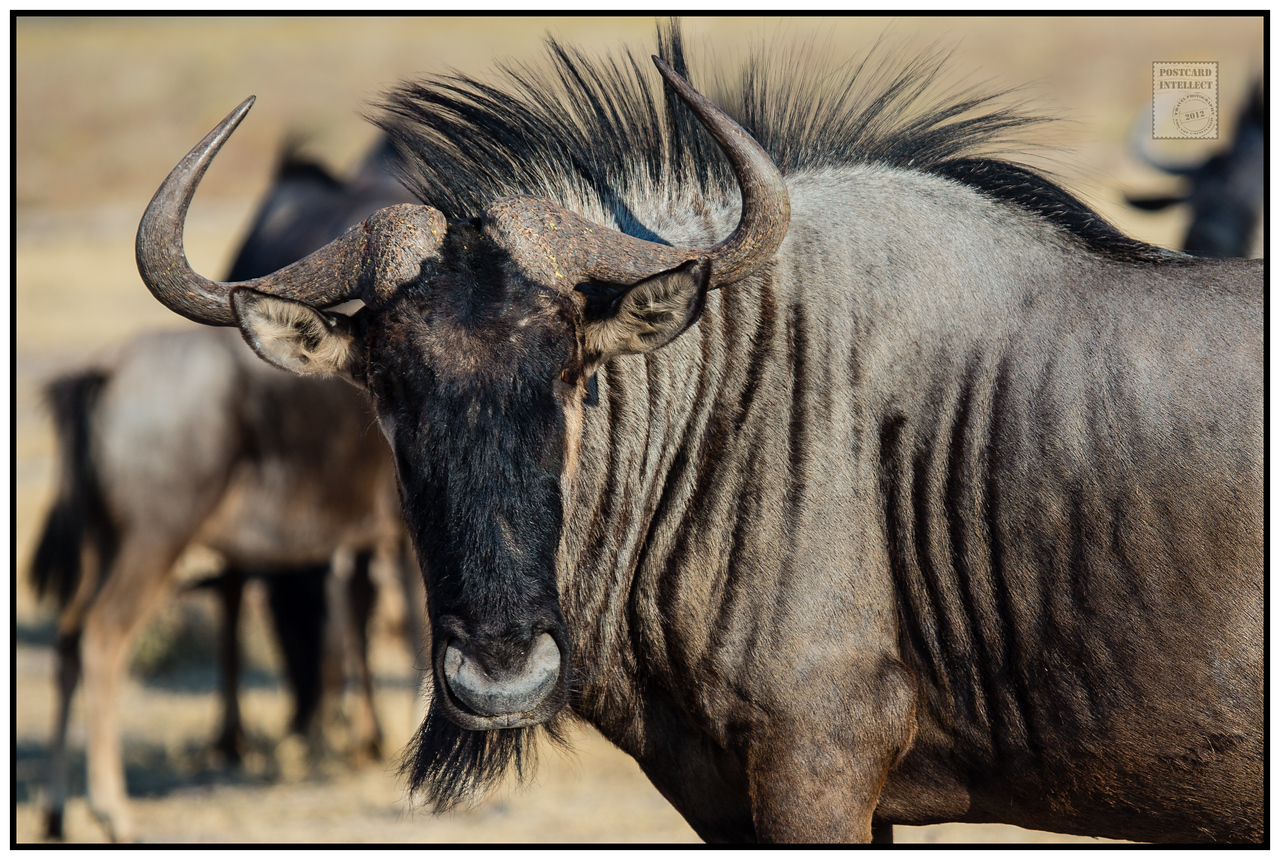
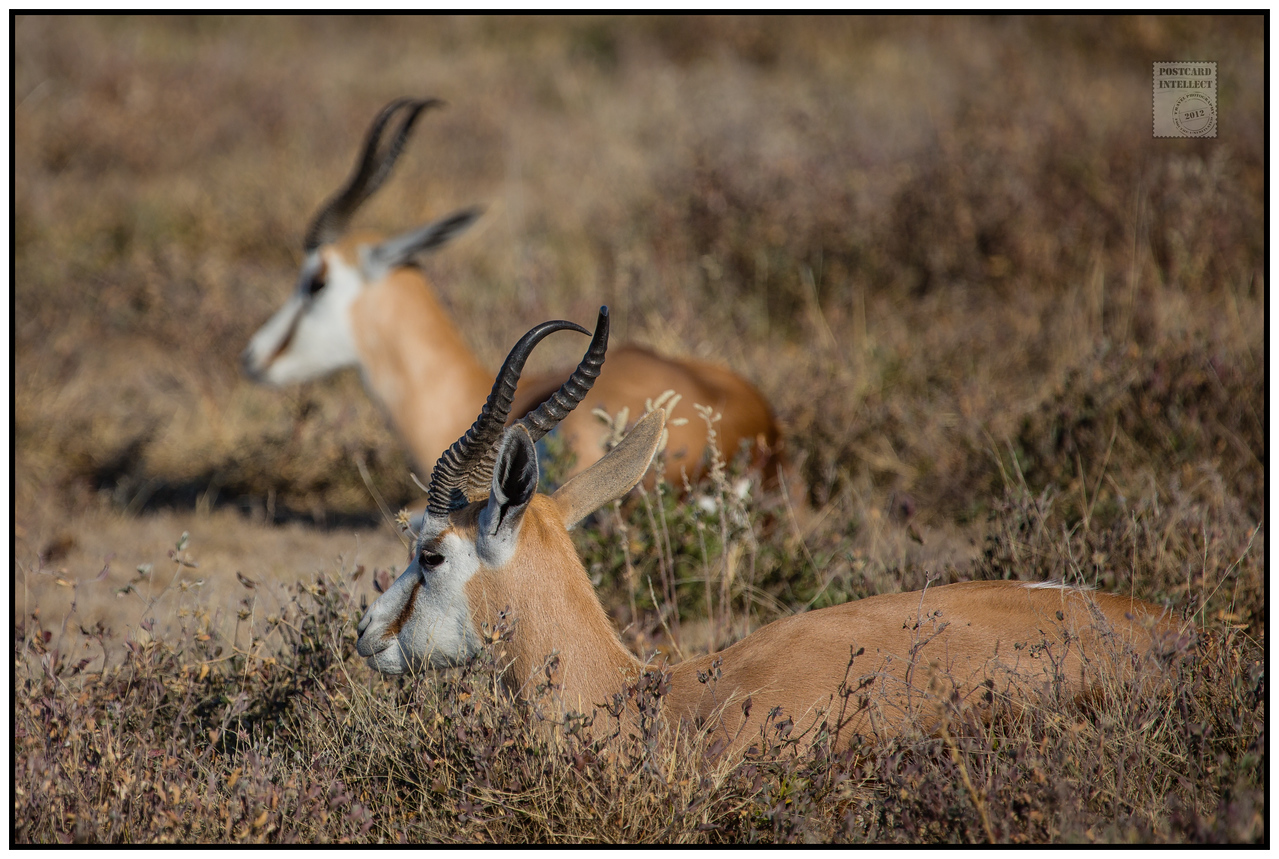
We also saw other ungulates while on safari – including wildebeest, giraffes, and antelope.  In Namibia the “antelope du jour” is the Springbok, which is very common.  By the end of the trip we had seen so many of them that we sort of drove by and barely glanced at them without taking a picture.  Imagine that – me not taking a picture! 🙂

For all of the pictures above, I generally use the same camera setting – I set the camera to aperture priority mode and maintain an aperture anywhere between f/5.6 and f/8.0 or f/9.0.  This makes sure that I get the bulk of the image in crisp focus but due to the zoom of the lens I also get some blur in the background.  I shoot with the focus in One Shot AF, which means that when I press the shutter button halfway the autofocus kicks in but it doesn’t track.  If you look at the photos above, these animals aren’t moving (at least not moving fast).  So One Shot AF works fine and is my preferred setting for the stationary animals. Later in the day we saw some elephants at a great watering hole near Halali.  They honestly came in droves and it was a beautiful location; we had shaded seats to watch the big guys walking around.

This brings me to another point when doing safari photography, and that’s the challenge with composition.  Unless you’re paying insane amounts of money, you’re generally sitting in a jeep of some sort, with other people, and restricted to certain roads, watering holes or rest stops (if you work for the BBC or are a professional nature photographer, you’re reading the wrong blog!)  This creates a challenge when it comes to composition.  Ideally you’d want to get a picture of an elephant with more than just a natural background – you’d want to be standing close to it, take it from the ground looking upwards (I know, a bit frightening…) or do something else clever. Since I’m limited in situations like this, I focus on getting pictures as sharp as I can and then think a lot about the magic word – CROP.  All of the images above were cropped to create a more interesting composition.  I take full size images with my camera to ensure a relatively high quality when cropping; this isn’t required and requires a bit more diligence (as an example, you have to be willing and almost aggressive in deleting pictures that you’re not going to use, or else your hard drive will fill up too fast).  In the photos above I cropped close on several images to get the elephants skin up close; the wrinkles and texture really add a prehistoric look to these pachyderms.

In addition to the big mammals, we were fortunate enough to see some birds as well.  I love the picture below of the Lilac Breasted Roller – this has to be one of the most beautiful birds in the world, and I love how sharp this picture came out.

We also saw some other birds on our trip, including this “Bustard” walking through the grass.

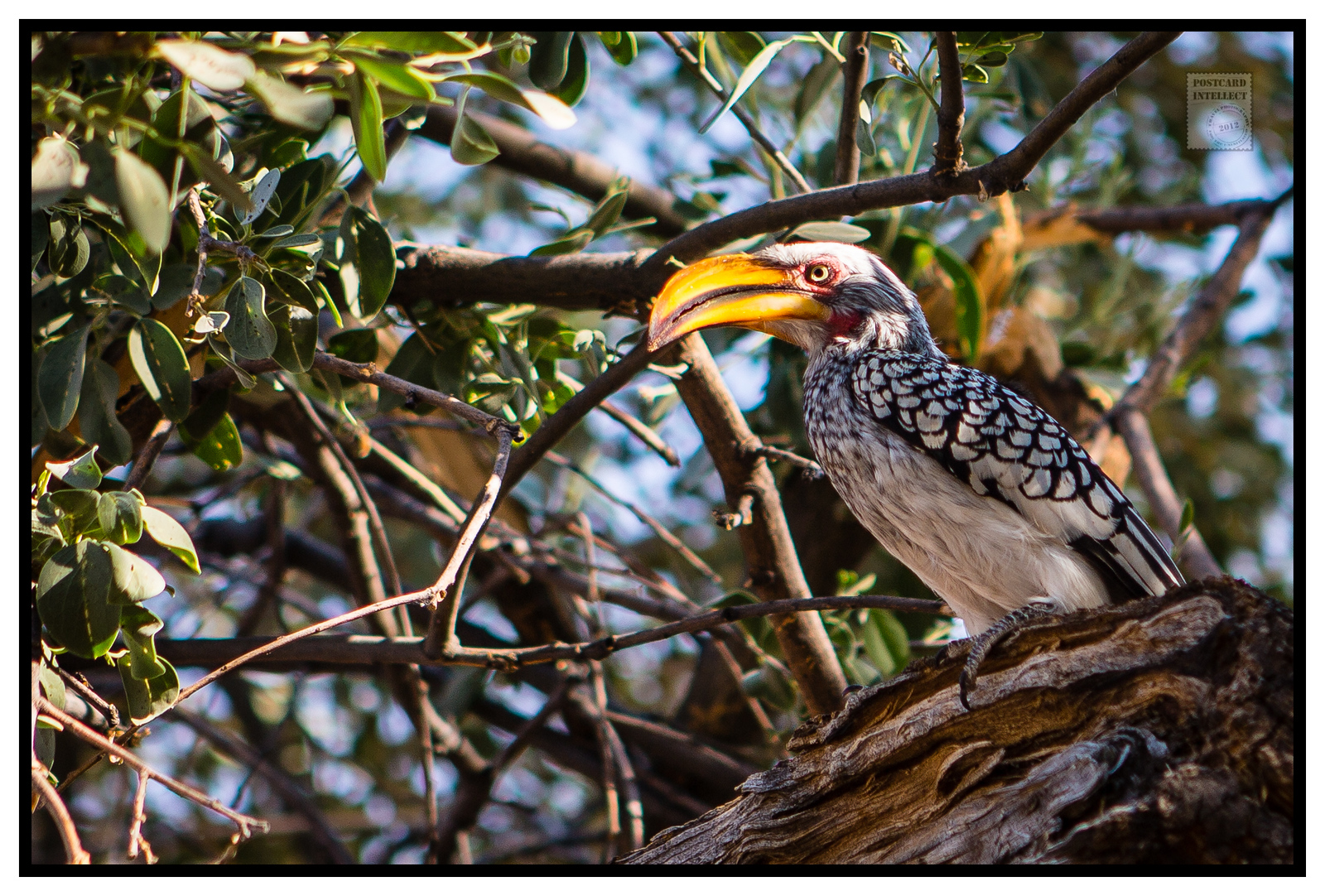
And this picture of the hornbill – it was kinda funny to see these guys flying around, it’s almost like the huge banana on their bill is so non-aerodynamic that they look out of control as they get airborne! And finally probably my favorite photo of birds, is these two owls that we took at the famous Okaukeujo Watering Hole; I think they’re Cape Eagle Owls.

This picture absolutely required a tripod – I tried numerous times to get the shot but the exposure time was a few seconds and it never failed that the owls would move ever so slightly to create a blurry image.  So I bumped up the ISO and kept trying, eventually capturing one that was satisfactory.  And when I first started shooting I didn’t even realize there were two in the tree!  I just love owls – I really do think they have an aura about them as being wiser than other animals.  For a close up of the image above just click on it. The watering hole where the above picture was taken is incredible – it was walking distance from our camp, so I spent a lot of time there and was able to capture the two images below of these beautiful white rhino’s stopping for a drink.  I particularly like the reflection in the first image.

The picture above was actually taken at an extremely high ISO – 25,600.  My new camera handles noise pretty well, but when jacked up that high it was definitely noticeable.  I used noise reduction through Lightroom and that cleaned the image up nicely. We were also extremely lucky on our safari to see one of the most elusive animals in Africa – the Leopard!  And we saw one in broad daylight, slinking from one shady spot to another.  Here’s an image of him walking, and then he posed very nicely for me to capture the next image.

It’s funny when taking pictures of carnivores, especially the big cats.  I just want to see them hunt SO BADLY.  I picture myself as Jon Attenborough, communicating with a helicopter overhead to co-ordinate the photoshoot in line with the animals hunt.  Instead I sit in a roasting car, waiting for the lazy cat do do anything! 🙂 We also saw a lion on our trip, which is posted in the first photo opening this series.  Did you notice the lion, on the right hand side of the picture?  It’s a male lion with a mane that’s still being developed (similar to a young guy trying to grow a mustache a little too early!)

Thing brings me to another point of advice while doing safari photography, and that’s the zoom reach of your lens.  You MUST have a whopping zoom, or you’re constantly going to struggle in getting “close” enough to the animals.  I’m fortunate in that my friend Alan let me borrow his lens, a 100-400 mm f/4.5-5.6 L series with IS.  This lens is absolutely perfect for safari.  I also have my own lens, a 70-200 f/4 L IS, but I chose not to bring it because the 200 mm simply isn’t long enough.  I’m also shooting on a full frame camera, so I’m really only getting 400 mm.  When I used to shoot with my Canon 50D, which is an APS-C size, I would be getting closer to 640 mm because it automatically “crops” due to sensor size by a factor of 1.6.  I try not to change lenses; if I want to take a wide angle photo I use my S100.

I’ll close out this post with some other pictures that I took and I thought were worth sharing.  There’s then a summary of best practices for successful safari photography, and finally some links to my favorite images in case you’d like to purchase a print.

The two pictures above were taken at watering holes during our various camps.  The one above is one of my favorites as you can see the incredible night sky that Namibia is famous for.  I took a TON of photos of the night sky, trying to perfect some star trail photography so I’ll be sharing that in another post.

Five Photography Tips while on Safari

  1. Use a long zoom lens – I believe that at least 400 mm is required, although some will get by with 200 or 300 mm.  Image Stabilization or Vibration reduction will help a lot.
  2. Shoot in Av or A mode (Aperture Priority) and keep the aperture around f/5.6 up to f/9.0.  As with anything it depends on what you’re shooting, but generally on an African Safari you’ll have sunny conditions and won’t need to open up your lens all the way.  Keeping the aperture at a middle range also ensures that you get more of the animal in focus.
  3. For stationary shots, keep the camera in one-shot mode.  If you’re fortunate enough to capture a Cheetah running or something like that then by all means switch to AI Servo, but for the conditions I’ve been in on safari I find that those situations are pretty rare.
  4. To stabilize the camera, I DON’T use a tripod.  In a car or jeep the tripod is too bulky. Generally you’ll either be standing in a jeep where the top gets moved up, or you’ll be in a car shooting out an open window.  Either way you’ll be able to support your camera from the car, on the windowsill for example.  The one thing some people suggest is a bean bag, to act as a cushion between the car and the camera.  I think this is yet another thing to bring and add to your bag – instead use a sock or a t-shirt that you wore the day before.  Does the same thing and it’s one less thing that you need to pack.  Some people do use a monopod; again I think this is a bit much but if you can find out in advance what kind of car you’ll be in you can make your own choice.
  5. As mentioned above, composition can be a challenge.  While taking pictures, think about not just the image that you’re seeing in the frame but also the possibility of how you could crop that image for a more interesting composition.  Taking pictures of the animals is easy enough, but getting pictures of them doing interesting things or an image that draws the viewer in is a real challenge in safari photography.

Finally I’ll close with a few images that I think are the better ones.  If you click on any of these it will take you to my SmugMug portfolio where you can purchase the image.  I hope you like this first write-up on Namibia – we did a TON of stuff so I’m sure this trip will keep me writing for quite some time (as I process the photos that is!)

Create a free website or blog at WordPress.com.

Up ↑

Design a site like this with WordPress.com
Get started